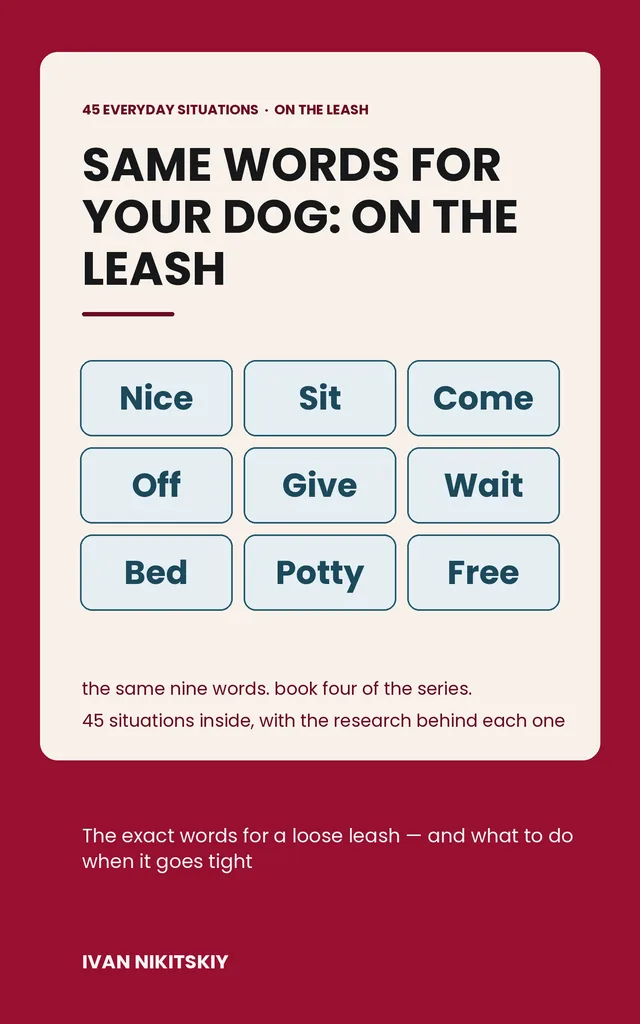
Same Words for Dogs · Book 4
Loose-leash training for everyday walks
Same Words for Your Dog: On the Leash
Reward-Based Training for Walking Without Pulling
The exact words for a loose leash—and what to do when it goes tight.
Read a free book examplePaperback and Kindle editions · 45 everyday situations
First, decide what a loose leash looks like
A dog being close and a leash being loose are not always the same thing. Situation 12, “What slack actually looks like”, makes the target visible to everyone holding the leash.
Same words · Book excerpt
"Nice" - marker, the sound that means the food is coming
Do this · Book excerpts
Watch the leash rather than the dog and name what you see.
Set the rule out loud: a curve in the line earns something.
Pay the curve wherever he stands, including behind your heel.
Say Nice at the moment the tension drops, not a second afterward.
Avoid this · Book excerpt
“Paying him for being close while the line is still tight.”
When to ask for help · Book excerpt
Get a trainer out if you cannot buy a curve at all, even on an empty street with food in your hand.
Here “Nice” marks a moment and predicts food; it is not a command to pull the dog into position. These selected lines define the target. The linked guide shows the next steps for marking, turning and resetting, with their limits.
Source: Same Words for Your Dog: On the Leash by Ivan Nikitskiy · Book 4, situation 12.
The labelled quotations are excerpts supplied by the author. Introductions, headings and planner suggestions are website additions. Read the approach and its limits.
What the full book adds
The full book moves from equipment and the doorway to loose-leash practice, distractions, greetings and situations that need professional help. This sample covers one target, not all 45 situations.
View the book on Amazon ↗This book may help if
The same moment keeps going differently.
- Walks begin with pulling, lunging, freezing, or tangled handoffs.
- Your dog can walk nicely in one place but loses the skill around distractions.
- More than one person walks the dog and each person responds differently.
Inside the book
- 01Loose-leash foundations and short practice loops
- 02Passing people, dogs, doorways, corners, and exciting smells
- 03Simple roles for the person holding the leash and anyone walking with them
The same vocabulary in every book